Ways to join
Prolonged Field Care Podcast
$4.99/month
- Bonus episodes
- Video episodes
- Early access
For members only
829 episodes
- SOMSA'26 - Synthetic Blood Substitutes In Far-Forward Special OperationsProlonged field care often means holding casualties far from a reliable blood supply. In this episode, recorded with the sponsorship and support of the Special Operations Medical Association, a UK prehospital medic with 16 years of service presents a University College Cork diploma thesis on what to do when whole blood at the point of wounding is running out.The talk argues that, in a contested large-scale conflict, whole blood at the front is hard to sustain: screening, cold chain, power, and s
- SOMSA'26 - Synthetic Blood Substitutes In Far-Forward Special OperationsProlonged field care often means holding casualties far from a reliable blood supply. In this episode, recorded with the sponsorship and support of the Special Operations Medical Association, a UK prehospital medic with 16 years of service presents a University College Cork diploma thesis on what to do when whole blood at the point of wounding is running out.The talk argues that, in a contested large-scale conflict, whole blood at the front is hard to sustain: screening, cold chain, power, and s
- Hypothermia in PFC: Prevention beats RewarmingProlonged field care (PFC) means holding casualties for hours or days, and once the bleeding is stopped, the patient still has to be kept warm. Dennis talks with Kevin, following their earlier episode on nursing care, about a part of patient care he sees get missed a lot: hypothermia management.They walk through how the body loses heat (radiation, convection, conduction, evaporation and the airway) and why a token Ready-Heat and a blanket are not enough, especially if the patient is on a bare li
- Hypothermia in PFC: Prevention beats RewarmingProlonged field care (PFC) means holding casualties for hours or days, and once the bleeding is stopped, the patient still has to be kept warm. Dennis talks with Kevin, following their earlier episode on nursing care, about a part of patient care he sees get missed a lot: hypothermia management.They walk through how the body loses heat (radiation, convection, conduction, evaporation and the airway) and why a token Ready-Heat and a blanket are not enough, especially if the patient is on a bare li
- Your Blood Supply Needs a PlanHow do you keep whole blood ready for transfusion when evacuation is delayed and resupply is uncertain?Dennis sits down with Monty from Delta Development, a former Army and Special Forces medic, to discuss blood cold-chain logistics in prolonged field care. Drawing on operational experience, they explore the challenge of getting blood products farther forward—and maintaining temperature control throughout the mission.Topics include ambient heat and advertised cooler endurance, blood storage vers
- Your Blood Supply Needs a PlanHow do you keep whole blood ready for transfusion when evacuation is delayed and resupply is uncertain?Dennis sits down with Monty from Delta Development, a former Army and Special Forces medic, to discuss blood cold-chain logistics in prolonged field care. Drawing on operational experience, they explore the challenge of getting blood products farther forward—and maintaining temperature control throughout the mission.Topics include ambient heat and advertised cooler endurance, blood storage vers
- Decision to Save the Limb - Wartime Tourniquet ConversionDr. John Holcomb returns to discuss a Ukrainian single-center paper on morbidity and mortality from ischemia-reperfusion injury after prolonged tourniquet use. One forward surgery team saw roughly 1,945 patients over nine months. After excluding obviously non-salvageable limbs, minor injuries with short tourniquet times, and patients with major non-extremity injuries, 74 cases remained. These were the patients in whom the surgeons decided the limb was worth trying to save.Assessment used the cla
- Decision to Save the Limb - Wartime Tourniquet ConversionDr. John Holcomb returns to discuss a Ukrainian single-center paper on morbidity and mortality from ischemia-reperfusion injury after prolonged tourniquet use. One forward surgery team saw roughly 1,945 patients over nine months. After excluding obviously non-salvageable limbs, minor injuries with short tourniquet times, and patients with major non-extremity injuries, 74 cases remained. These were the patients in whom the surgeons decided the limb was worth trying to save.Assessment used the cla
- 301: MARCH Works - Wound Care and TBI are NEXT LayerStacey Shackelford retired from the Air Force after serving as Joint Trauma System chief and trauma medical director in Colorado Springs. She now works at the Center for Combat Medicine at the University of Colorado. Dennis brings her on to walk through the 2021 case-control analysis of prehospital death and prolonged field care survival from U.S. combat operations between 2007 and 2015.The study pulled patients with documented prehospital care lasting four to seventy-two hours and an AIS of two
- 302: TBI in TCCC- Not EVERY TBI ExpectantEric DeSoucy is a U.S. Air Force trauma surgeon. He previously served as a flight doc for pararescue and recently led the COTCCC TBI working group that re-examined the 2024 guidelines.The biggest practical change is assessment. Full GCS remains difficult under fire and even in the trauma bay. The update simplifies the field decision to whether the patient can follow a clear command (thumbs-up, squeeze, blink, shrug). A solid response means they are not routed down the moderate-to-severe pathway.
- Neck Junctional Injuries: Zones, Pressure, and PlacementMax and Dennis walk through neck and upper-chest junctional injuries, the pattern he expects more of with top-down penetrating trauma.The neck is divided into three zones for a reason. Zone 1 (sternal notch to cricoid) raises immediate concern for chest involvement and the need for sternotomy or similar exposure. Zone 2 (cricoid to the angle of the jaw) is the most accessible surgically; the anterior border of the sternocleidomastoid is the landmark for the trail of safety. Zone 3 (angle of the
- Neck Junctional Injuries: Zones, Pressure, and PlacementMax and Dennis walk through neck and upper-chest junctional injuries, the pattern he expects more of with top-down penetrating trauma.The neck is divided into three zones for a reason. Zone 1 (sternal notch to cricoid) raises immediate concern for chest involvement and the need for sternotomy or similar exposure. Zone 2 (cricoid to the angle of the jaw) is the most accessible surgically; the anterior border of the sternocleidomastoid is the landmark for the trail of safety. Zone 3 (angle of the
- 300: What Are We Missing? SOF Medics on Veteran Suicide17.7 veterans die by suicide every single day. Almost everyone listening knows someone. Episode 300 of the PFC Podcast puts three retired special operations medics in the room to talk about why the people who looked fine still did it, and what the rest of us can actually do.Justin is a retired Special Forces medic who went back to school and now practices as a clinical social worker. Mike spent just under 27 years as a special operations medic and has been a contractor at the special operations
- 301: MARCH Works - Wound Care and TBI are NEXT LayerStacey Shackelford retired from the Air Force after serving as Joint Trauma System chief and trauma medical director in Colorado Springs. She now works at the Center for Combat Medicine at the University of Colorado. Dennis brings her on to walk through the 2021 case-control analysis of prehospital death and prolonged field care survival from U.S. combat operations between 2007 and 2015.The study pulled patients with documented prehospital care lasting four to seventy-two hours and an AIS of two
- When does Nursing Care start?Kevin is a nurse anesthetist with more than a decade of bedside nursing. Dennis brings him on to talk about the part of prolonged field care that the CPG describes but does not time: nursing care.The conversation starts with a practical definition. Life-saving interventions finish, and the patient is stabilized. That is when nursing begins. In a hospital, this is the handoff to the floor, PACU, or ICU. In the field, it is the moment after the tourniquet is converted, the amputation is complete,
- When does Nursing Care start?Kevin is a nurse anesthetist with more than a decade of bedside nursing. Dennis brings him on to talk about the part of prolonged field care that the CPG describes but does not time: nursing care.The conversation starts with a practical definition. Life-saving interventions finish, and the patient is stabilized. That is when nursing begins. In a hospital, this is the handoff to the floor, PACU, or ICU. In the field, it is the moment after the tourniquet is converted, the amputation is complete,
- 299 - TCCC Analgesia: After the Opioids LeftWe covered the new analgesia guidelines from TCCC, now lets talk about how to get it done.Ryan Knight — emergency physician and Deep, Army anesthesiologist now at UNC, walk the new battlefield analgesia list.Ryan’s views are his. Not the committee’sWhat is on the card: acetaminophen, meloxicam, suzetrigine, ketamine, S-ketamine. Can you treat a combat wound with that? Both say yes — because ketamine is versatile and APAP plus a COX-2 actually work on traumatic pain. Suzetrigine is the unknown. P
- 300: What Are We Missing? SOF Medics on Veteran Suicide17.7 veterans die by suicide every single day. Almost everyone listening knows someone. Episode 300 of the PFC Podcast puts three retired special operations medics in the room to talk about why the people who looked fine still did it, and what the rest of us can actually do.Justin is a retired Special Forces medic who went back to school and now practices as a clinical social worker. Mike spent just under 27 years as a special operations medic and has been a contractor at the special operations
- SOMA '26 - Lessons Learned: Humanitarian Field Hospitals in Syria and GazaRecorded live at SOMA 26Dr. Sam, an orthopedic and surgical oncologist, shares hard-won lessons from humanitarian deployments in Syria, Ukraine, and Gaza. Operating in underground basements under airstrikes, he describes mass-casualty events that overwhelm capacity (hundreds arriving at once, patients dying on the doorstep), the deliberate targeting of marked hospitals and medical personnel, and the practical realities of war surgery when blood, space, evacuation, and supplies are exhausted. Cor
- SOMA '26 - Lessons Learned: Humanitarian Field Hospitals in Syria and GazaRecorded live at SOMA 26Dr. Sam, an orthopedic and surgical oncologist, shares hard-won lessons from humanitarian deployments in Syria, Ukraine, and Gaza. Operating in underground basements under airstrikes, he describes mass-casualty events that overwhelm capacity (hundreds arriving at once, patients dying on the doorstep), the deliberate targeting of marked hospitals and medical personnel, and the practical realities of war surgery when blood, space, evacuation, and supplies are exhausted. Cor
- -40 Changes MARCH: Arctic TCCCA healthy person lying in the snow at -30 or -40 dies of hypothermia. Add a gunshot wound, wet clothes, and twenty minutes on the X while the team finishes the fight, and the cold competes with the bleeding.Thomas spent nine years as a Danish Special Forces operator and medic. His view is that TCCC still applies, but the sequence does not survive contact with that climate unchanged.Stripping a chest or abdomen to “do MARCH” on the snow makes the patient colder, more coagulopathic, and more acido
- -40 Changes MARCH: Arctic TCCCA healthy person lying in the snow at -30 or -40 dies of hypothermia. Add a gunshot wound, wet clothes, and twenty minutes on the X while the team finishes the fight, and the cold competes with the bleeding.Thomas spent nine years as a Danish Special Forces operator and medic. His view is that TCCC still applies, but the sequence does not survive contact with that climate unchanged.Stripping a chest or abdomen to “do MARCH” on the snow makes the patient colder, more coagulopathic, and more acido
- When is When: Withdrawing Interventions in PFCMedics add interventions easily. Prolonged field care is where those interventions start charging rent. Dave walks the unwind.A cut endotracheal tube used as a cric can come out if the patient no longer needs it. Unhook the bag. Moving air through the tube, following commands, and a normal breathing pattern are good signs. Cuff down: if he cannot breathe around it, edema or a flap may be waiting, and pulling can lose the airway. Suction above the cuff first. Dress the site after. Do not pull the
- When is When: Withdrawing Interventions in PFCMedics add interventions easily. Prolonged field care is where those interventions start charging rent. Dave walks the unwind.A cut endotracheal tube used as a cric can come out if the patient no longer needs it. Unhook the bag. Moving air through the tube, following commands, and a normal breathing pattern are good signs. Cuff down: if he cannot breathe around it, edema or a flap may be waiting, and pulling can lose the airway. Suction above the cuff first. Dress the site after. Do not pull the
- 298 - Starting a VA Disability Claim After the ServiceThe internet will tell you how to “win” a VA claim. Almost none of it is how the exam is actually written.Will spent 11 years Navy EOD, 9 as a SOF medic, and now sits as a National Guard battalion PA. In the middle he worked the other side of the table: third-party C&P exams. Meet the veteran. Fill the cookie-cutter form. Ship it to the VA actuaries. He never got Genesis. He got whatever dump the system decided was fit to send — problem lists, notes, radiology reports, and every PHA where you ch
- 299 - TCCC Analgesia: After the Opioids LeftWe covered the new analgesia guidelines from TCCC, now lets talk about how to get it done.Ryan Knight — emergency physician and Deep, Army anesthesiologist now at UNC, walk the new battlefield analgesia list.Ryan’s views are his. Not the committee’sWhat is on the card: acetaminophen, meloxicam, suzetrigine, ketamine, S-ketamine. Can you treat a combat wound with that? Both say yes — because ketamine is versatile and APAP plus a COX-2 actually work on traumatic pain. Suzetrigine is the unknown. P
- Blood Sweep, Deep Breath, Pulse Check: Point-of-Injury TriageMost of us were taught START, the sieve, RAMP, DIME, P1–P3. Andrew — EM physician on a small surgical team out of Fort Liberty — used none of it the night a helicopter went down with 22 people on board.The rest of his medical team could not walk. Dust, firelight, yelling. Thirty-to-sixty seconds per patient on a linear algorithm is ten minutes before you reach number ten. People die of massive hemorrhage and lost airway in that window.So he ran a binary pass: dying now or not. Blood sweep. “Take
- Blood Sweep, Deep Breath, Pulse Check: Point-of-Injury TriageMost of us were taught START, the sieve, RAMP, DIME, P1–P3. Andrew — EM physician on a small surgical team out of Fort Liberty — used none of it the night a helicopter went down with 22 people on board.The rest of his medical team could not walk. Dust, firelight, yelling. Thirty-to-sixty seconds per patient on a linear algorithm is ten minutes before you reach number ten. People die of massive hemorrhage and lost airway in that window.So he ran a binary pass: dying now or not. Blood sweep. “Take
- Don’t Wait for Hypotension: Resuscitation Decision-MakingDennis sits down with Max to walk through hemorrhagic shock the way it actually behaves in young, healthy military-age casualties—not the tidy textbook ladder of Class I–IV. They start with the only split that matters: compensated versus uncompensated. Class I–II means the body is still delivering oxygen to organs. Class III–IV means it is not, and the damage is no longer a simple volume problem.Max breaks compensation into “gears”: venous reserve first (no vital-sign change), then heart rate, p
- Don’t Wait for Hypotension: Resuscitation Decision-MakingDennis sits down with Max to walk through hemorrhagic shock the way it actually behaves in young, healthy military-age casualties—not the tidy textbook ladder of Class I–IV. They start with the only split that matters: compensated versus uncompensated. Class I–II means the body is still delivering oxygen to organs. Class III–IV means it is not, and the damage is no longer a simple volume problem.Max breaks compensation into “gears”: venous reserve first (no vital-sign change), then heart rate, p
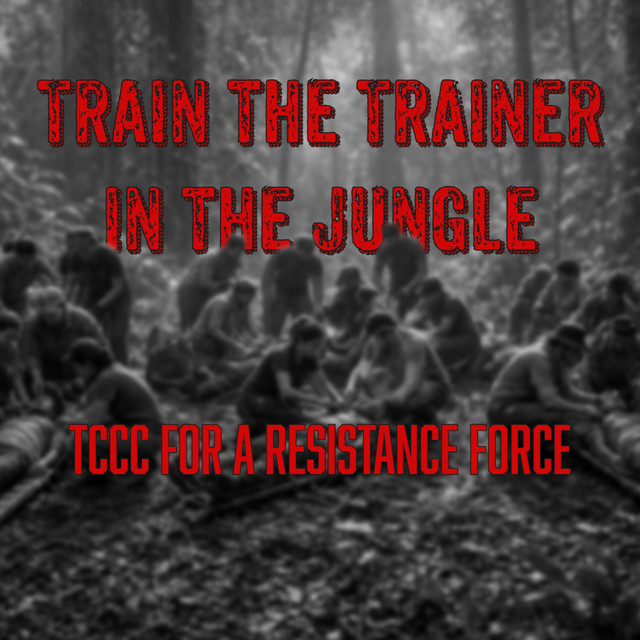
- 297 -Train The Trainer In The Jungle TCCC For A Resistance ForceBen walks Dennis through a six-month plan that became a jungle course for about 200 unpaid resistance volunteers. Vic built the curriculum from TCCC, the Ranger Medic Handbook, and what that force actually needed — then wrote it to their education level, culture, and organization. Supplies moved through the existing network. The first four days were not student training. They were instructor train-up. Then the locals taught. Interpreters shrank. Force multiplication went up. Chiefs owned the sch
- 298 - Starting a VA Disability Claim After the ServiceThe internet will tell you how to “win” a VA claim. Almost none of it is how the exam is actually written.Will spent 11 years Navy EOD, 9 as a SOF medic, and now sits as a National Guard battalion PA. In the middle he worked the other side of the table: third-party C&P exams. Meet the veteran. Fill the cookie-cutter form. Ship it to the VA actuaries. He never got Genesis. He got whatever dump the system decided was fit to send — problem lists, notes, radiology reports, and every PHA where you ch
- Pack to the Vessel: Hemorrhage Control Is Not a Mind-less SkillMike Weisman — 25 years as a Navy Corpsman and SARC, 27 years on a busy Vegas fire department, now clinical education at Celox — does not sell magic dust. He sells a hydraulic problem.A femoral-rate bleed can dump on the order of 500 mL a minute. The clotting cascade is a 14-step masterpiece built for arterioles, not that jet. Early platelet plug gets blown off the vessel wall unless something holds equal pressure against it. Tourniquet, packed gauze, or packed hemostatic gauze: all of them are
- Pack to the Vessel: Hemorrhage Control Is Not a Mind-less SkillMike Weisman — 25 years as a Navy Corpsman and SARC, 27 years on a busy Vegas fire department, now clinical education at Celox — does not sell magic dust. He sells a hydraulic problem.A femoral-rate bleed can dump on the order of 500 mL a minute. The clotting cascade is a 14-step masterpiece built for arterioles, not that jet. Early platelet plug gets blown off the vessel wall unless something holds equal pressure against it. Tourniquet, packed gauze, or packed hemostatic gauze: all of them are
- 297: Train The Trainer In The Jungle: TCCC For A Resistance ForceBen walks Dennis through a six-month plan that became a jungle course for about 200 unpaid resistance volunteers. Vic built the curriculum from TCCC, the Ranger Medic Handbook, and what that force actually needed — then wrote it to their education level, culture, and organization. Supplies moved through the existing network. The first four days were not student training. They were instructor train-up. Then the locals taught. Interpreters shrank. Force multiplication went up. Chiefs owned the sch
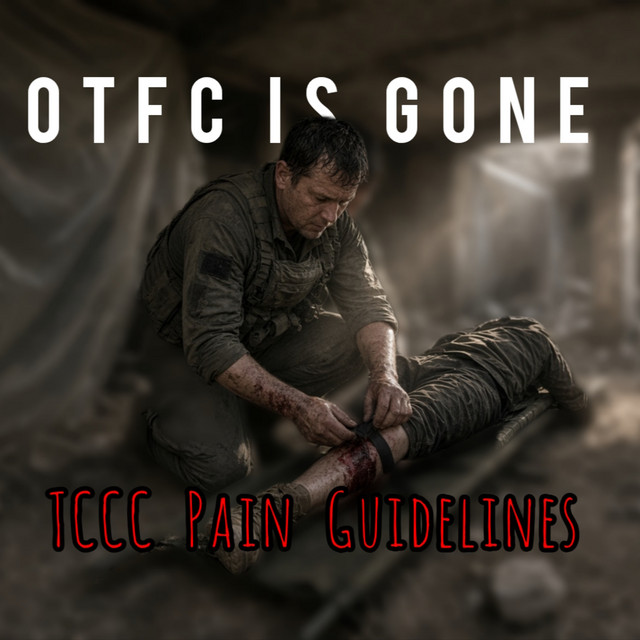
- 296 - Mission Capable Pain Control: The TCCC Analgesia Update ExplainedOTFC is gone. That was not a small supply hiccup. It punched a hole in the old TCCC pain plan.George Barbee, a PA and co-author of TCCC Guideline Change 25-03, walks Dennis through why the committee rebuilt battlefield analgesia instead of patching the old triple-option chart.They screened 56 analgesics. They built an objective matrix. They landed on suzetrigine: non-opioid, mentation-sparing, slow onset, long duration — a drug that can keep a still-fighting casualty in the fight and then carry
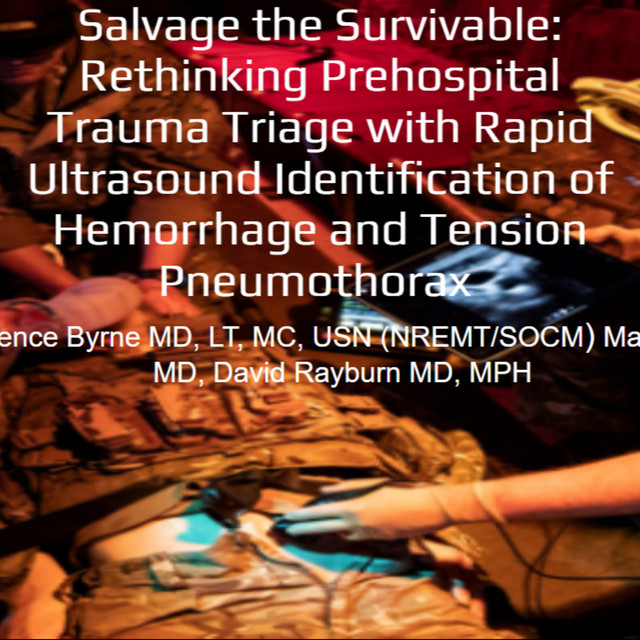
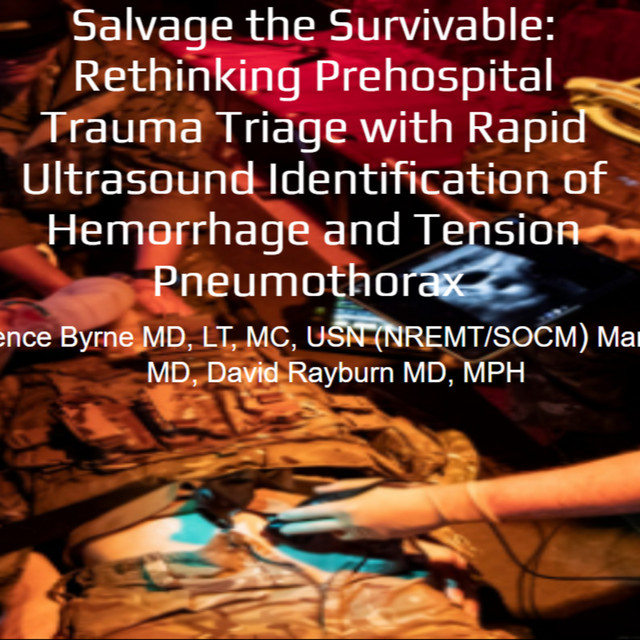
- SOMA 26' - Ultrasound-Augmented Triage A Proposal To Refine Field Decision Making In Tactical Combat Casualty CareRecorded live at SOMA 26In a near-peer MASCAL, one medic and one junior medic may face twenty penetrating torso casualties, one unit of blood, and no time to empirically needle or finger-decompress every chest. This SOMA presentation argues that formal triage algorithms are already giving way to intuitive, intervention-first decisions—and that point-of-care ultrasound can make that second pass objective. The proposed two-pass model keeps MARCH as a fast first pass (urgent vs non-urgent), then us
- SOMA 26' - Ultrasound-Augmented Triage A Proposal To Refine Field Decision Making In Tactical Combat Casualty CareRecorded live at SOMA 26In a near-peer MASCAL, one medic and one junior medic may face twenty penetrating torso casualties, one unit of blood, and no time to empirically needle or finger-decompress every chest. This SOMA presentation argues that formal triage algorithms are already giving way to intuitive, intervention-first decisions—and that point-of-care ultrasound can make that second pass objective. The proposed two-pass model keeps MARCH as a fast first pass (urgent vs non-urgent), then us
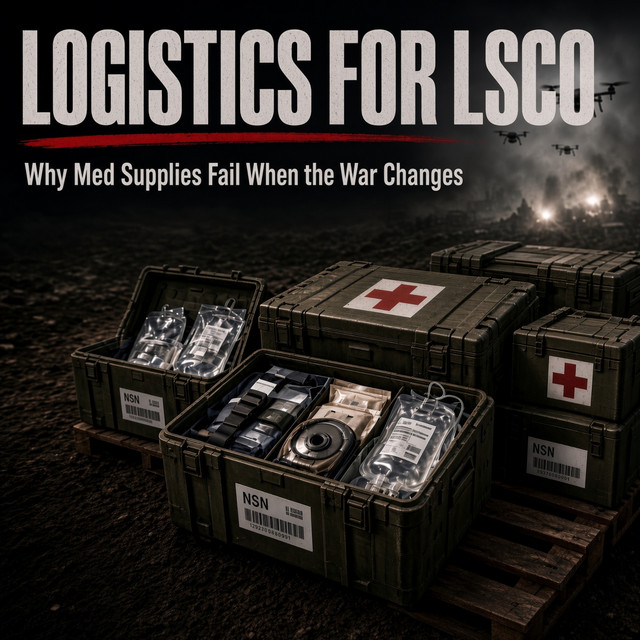
- 295- Logistics For LSCO: Why SOF Med Supplies Fail When The War ChangesMedical logistics was an afterthought for a lot of us in GWOT. You submitted a request, something showed up, and everyone joked that the warehouse never read the order. That model does not survive large-scale combat operations.In this episode, Dennis sits down with Jesse Bashel, a medical logistician and acquisitionist, to walk through how SOF medical supply is supposed to work—pre-deployment, on deployment, and after the first 15 days. They cover NSNs versus product names, automatic in-lieu sub
- 296 - Mission Capable Pain Control: The TCCC Analgesia Update ExplainedOTFC is gone. That was not a small supply hiccup. It punched a hole in the old TCCC pain plan.George Barbee, a PA and co-author of TCCC Guideline Change 25-03, walks Dennis through why the committee rebuilt battlefield analgesia instead of patching the old triple-option chart.They screened 56 analgesics. They built an objective matrix. They landed on suzetrigine: non-opioid, mentation-sparing, slow onset, long duration — a drug that can keep a still-fighting casualty in the fight and then carry
- SOMA 26' - Role 1.5: Fighting Tourniquet Syndrome at the ForefrontUkrainian orthopedic and reconstructive surgeon describes what prolonged field care actually looks like when evacuation from the front line to Role 2 takes three to four days, and sometimes longer. After years of Role 1, Role 2, and evacuation-stage work, he focuses on a problem that now drives limb outcomes: tourniquet syndrome. TCCC made rapid tourniquet application routine; the neglected next step is conversion, replacement, and complication prevention when the casualty remains in the field f
- SOMA 26' - Role 1.5: Fighting Tourniquet Syndrome at the ForefrontUkrainian orthopedic and reconstructive surgeon describes what prolonged field care actually looks like when evacuation from the front line to Role 2 takes three to four days, and sometimes longer. After years of Role 1, Role 2, and evacuation-stage work, he focuses on a problem that now drives limb outcomes: tourniquet syndrome. TCCC made rapid tourniquet application routine; the neglected next step is conversion, replacement, and complication prevention when the casualty remains in the field f
- 294 - Do Antibiotics Really Reduce Mortality in Trauma? Wound Care First in Prolonged Field CareAntibiotics are not magic. In this episode of the PFC Podcast, Dennis sits down with Ryan to cut through the common myth that “I’ve given antibiotics, so the wound is protected.” They unpack why vigorous wound care—irrigation, debridement of dead tissue, clean dressings, and early surgical washout—remains the foundation of infection prevention in combat and prolonged field care, while antibiotics only shift the probabilities after the basics are done.Drawing on historical military medicine (pre-
- 293- Logistics For LSCO: Why SOF Med Supplies Fail When The War ChangesMedical logistics was an afterthought for a lot of us in GWOT. You submitted a request, something showed up, and everyone joked that the warehouse never read the order. That model does not survive large-scale combat operations.In this episode, Dennis sits down with Jesse Bashel, a medical logistician and acquisitionist, to walk through how SOF medical supply is supposed to work—pre-deployment, on deployment, and after the first 15 days. They cover NSNs versus product names, automatic in-lieu sub
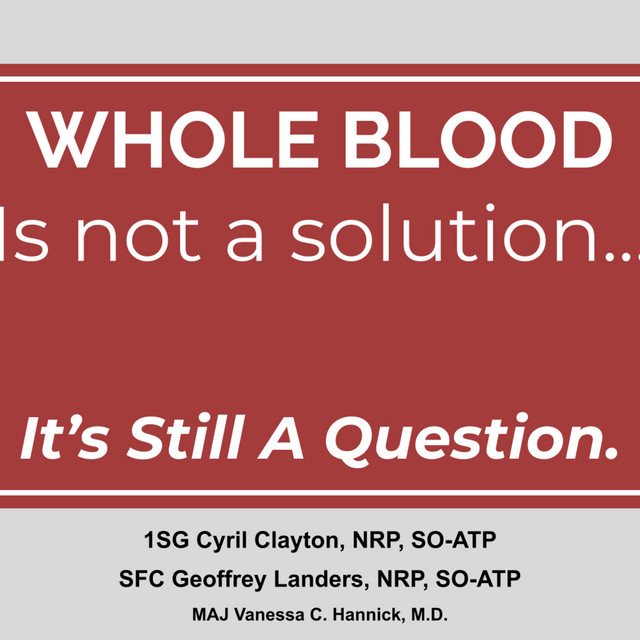
- SOMA 26' - Fresh Whole Blood is Not The Answer: It's Still a QuestionWhole Blood Is Not a Solution (Until Conventional Forces Can Deliver It)Recorded live at SOMA 26Dr. Vanessa Hanick (emergency physician, former active-duty Army, now National Guard) and 1SG Cy Clayton (Ranger Regiment veteran, currently a conventional Role 2 first sergeant) deliver a blunt assessment of a critical readiness gap: while whole blood is the agreed standard of care for damage control resuscitation, conventional forces remain largely unprepared to provide it in support of SOF or any l
- SOMA 26' - Fresh Whole Blood is Not The Answer: It's Still a QuestionWhole Blood Is Not a Solution (Until Conventional Forces Can Deliver It)Recorded live at SOMA 26Dr. Vanessa Hanick (emergency physician, former active-duty Army, now National Guard) and 1SG Cy Clayton (Ranger Regiment veteran, currently a conventional Role 2 first sergeant) deliver a blunt assessment of a critical readiness gap: while whole blood is the agreed standard of care for damage control resuscitation, conventional forces remain largely unprepared to provide it in support of SOF or any l
- 293 - Dead Tissue Kills in Prolonged Field Care: 4 C’s, Early Debridement & Delayed Primary Closure Lessons from the FieldIn this episode of the PFC Podcast, Dennis sits down with missionary surgeon Jason to cut through the noise on real-world wound care in austere and unconventional warfare environments. From the bridge two miles from the front to resource-scarce guerrilla settings, Jason shares hard-won lessons on getting tourniquets off, aggressive debridement, and keeping patients from dying of infection weeks later.You’ll hear why most tourniquets can (and should) come off early, how to use the 4 C’s (Color, C
- 294 - Do Antibiotics Really Reduce Mortality in Trauma? Wound Care First in Prolonged Field CareAntibiotics are not magic. In this episode of the PFC Podcast, Dennis sits down with Ryan to cut through the common myth that “I’ve given antibiotics, so the wound is protected.” They unpack why vigorous wound care—irrigation, debridement of dead tissue, clean dressings, and early surgical washout—remains the foundation of infection prevention in combat and prolonged field care, while antibiotics only shift the probabilities after the basics are done.Drawing on historical military medicine (pre-
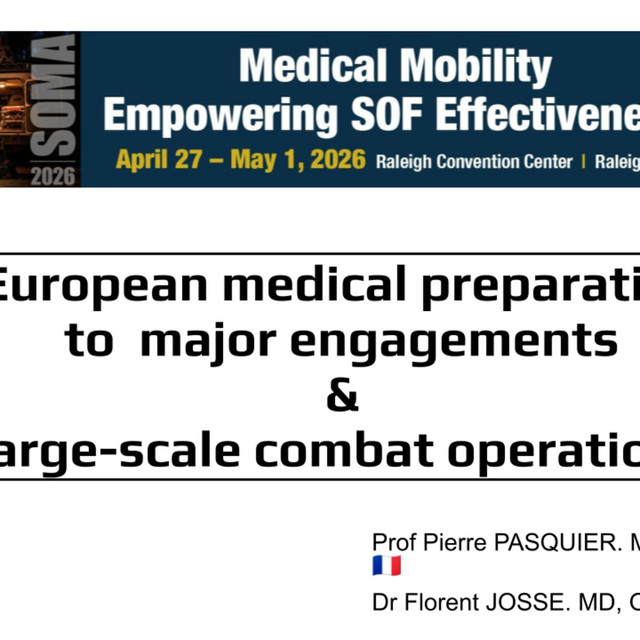
- SOMA 26' - European Medical Preparations for Major Engagements and Large-Scale Combat OperationsRecorded live at SOMA 26Pierre Pasquier (France) and his German counterpart deliver a clear-eyed assessment of how European military medical systems are preparing for large-scale combat operations and major engagements, drawing heavily on lessons from Ukraine. They examine the scale of expected casualties, the return of mass-casualty and prolonged-care realities, the threat of multi-drug-resistant organisms, the vulnerability of medical treatment facilities to deliberate attacks, and the urgent
- SOMA 26' - European Medical Preparations for Major Engagements and Large-Scale Combat OperationsRecorded live at SOMA 26Pierre Pasquier (France) and his German counterpart deliver a clear-eyed assessment of how European military medical systems are preparing for large-scale combat operations and major engagements, drawing heavily on lessons from Ukraine. They examine the scale of expected casualties, the return of mass-casualty and prolonged-care realities, the threat of multi-drug-resistant organisms, the vulnerability of medical treatment facilities to deliberate attacks, and the urgent